Not just a transition fuel: Donal Murphy on leading liquid gas into its next chapter 

19 Feb 2026

DCC plc's Chief Executive and recently-appointed President of the World Liquid Gas Association, Donal Murphy, shares his vision for the industry's future – and why he believes liquid gas is far more than a stopgap on the road to decarbonisation. 

When the World Liquid Gas Association (WGLA) announced DCC plc Chief Executive Donal Murphy as  its new president  in October 2025, it marked more than a personal milestone. It signalled a further shift in industry leadership: away from the large international energy groups that once dominated energy associations, and toward the distributors now shaping how fuel actually reaches customers.

"In the past, the big energy groups – the BPs, the Shells, the Exxons – used to dominate all the industry associations," Donal reflects. "A lot of them have pulled back from this part of the market. So I think it's incumbent on us to take that leadership position." 

For DCC, liquid gas is a priority for growth. But for Donal, the role is about something larger: ensuring the industry doesn't lose momentum on renewables at the very moment it matters most.

"Let's not take the foot off the pedal" 

Over the past 18 months, the global appetite for ESG-driven investment has cooled. Political shifts, post-conflict energy security concerns, and cost pressures have reshuffled priorities – and Donal sees a setback in that pivot.

"There's a risk that people will stop focusing on the renewable development piece because demand isn't there, it's hard work," he warns. "But for me, it's crucially important that as an industry we keep innovating, keep driving the agenda to produce lower carbon gases for our customers." 

That's the mantra he's bringing to the WLGA: to keep pushing bioliquid gas, renewable dimethyl ether (rDME), and other alternatives – even when short-term market signals suggest otherwise. When he completes his tenure as president after two years, he wants to look back and say the industry moved renewables forward, not sideways.

"If we don't, at some point the industry won't have a future because it'll just be pure fossil,” he points out. “That has to move on."

"You can't have one source of energy that ticks the box for all applications"

One misconception Donal encounters repeatedly – from policymakers, analysts, and even industry observers – is that liquid gas is simply a bridge to electrification. He pushes back on that framing.

"Electrification is not going to replace most high-intensity energy needs," he explains. "In five, 10, 20 years' time, there will still be a requirement for high-energy-intensive products delivered cost-effectively to customers in rural and off-grid areas."

Think rural distilleries, paper mills, quarries, and construction sites; these are businesses that need dense, portable energy where there is no natural gas pipeline. That's the core of the liquid gas proposition.

When DCC talks to industrial customers about their future energy needs, the conversation isn't about phasing out liquid gas. It's about transitioning to bioliquid gas and rDME – products with the same energy content, produced from non-fossil sources.

A global lens on a local product

The WLGA role has also widened Donal's perspective. At DCC, the focus is Europe and North America. But liquid gas serves over three billion people globally – many of them in developing regions, using it as their primary clean cooking fuel.

"When you rise up to the industry level, you see the power of a product in terms of what it can do for the benefit of the world," he says. "If you live in Ireland or the UK, liquid gas is a small part of the energy mix. But its impact on the world population is huge."

Sitting on the WLGA board alongside leaders from Brazil, Africa, and Southeast Asia has reinforced that global dimension. Conversations with peers like the CEO of Ultragaz in Brazil – or a former DCC colleague, Natasha Cambriels, now leading Total's liquid gas business in Africa – offer a window into markets with very different dynamics but shared challenges.

"We run similar businesses: we buy gas, put it into cylinders, put it into bulk tanks,” Donal explains. “But the dynamics of running a business in Brazil versus Europe are so different. That's very powerful."

Expanding into Central Europe 

Back at DCC, the liquid gas strategy is accelerating. In January 2026, the company announced its entry into four new European markets – Poland, Hungary, Czechia, and Slovakia – through the agreement to acquire UGI International's liquid gas businesses. An earlier deal in Austria rounded out the Central European footprint. 

"Poland is one of the largest liquid gas markets in Europe, a key market for us," Donal explains. "When you look at the structure UGI built, a strong Polish business with shared services that can manage smaller markets, that is ideal. It gives us a platform to scale."

It's a familiar playbook. DCC has acquired approximately 400 businesses in its history as a public company. The model: buy a strong local business with a good team, then consolidate to build density and efficiency: "Every time we move into a new market, we want to get to a leadership position. Being a leader delivers the best return for shareholders – and the best service for customers."
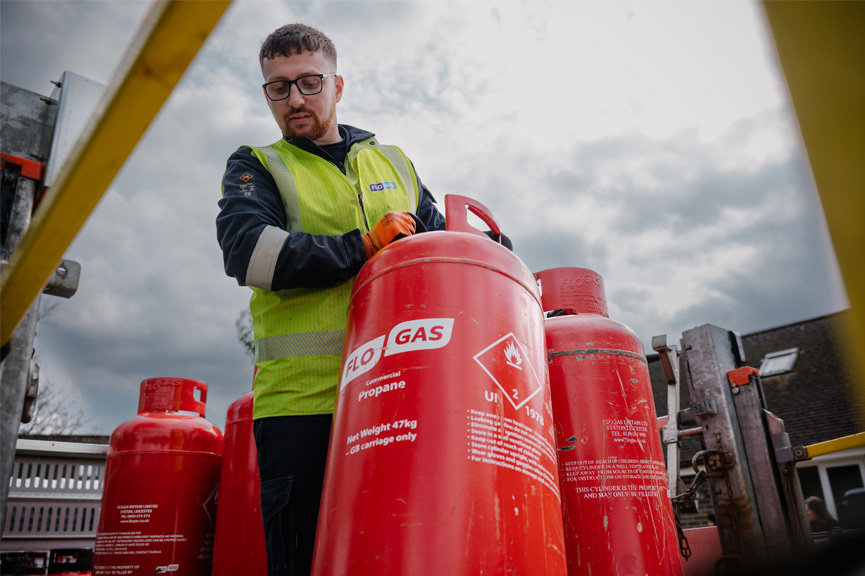

DCC Truck Driver

"Our people are our differentiator"

Since becoming Chief Executive in 2017, Donal has led DCC through a turbulent stretch: pandemic, energy crisis, inflation, geopolitical shocks. Through it all, performance has held strong.

"COVID was probably the biggest realisation of resilience," he recalls. "When it hit, we wondered how we'd survive. Actually, the first year of COVID we grew our profits. Everything we do is needed for everyday life – we had to find ways to get products to customers, and our people were phenomenal."

That theme, people making the difference, runs through Donal's leadership philosophy. Whether it's truck drivers navigating shipments in minus-20 temperatures in Illinois or teams adapting supply chains overnight, the workforce is what keeps essential energy flowing. "If it isn't for the drivers that go out in the snow, we can't do what we do. Our people are our differentiator," he notes.

The next 50 years

2026 marks DCC's 50th anniversary – and its most significant strategic shift since its foundation. The sale of healthcare and the planned sale of the remaining technology division has positioned energy as the sole focus, a departure from the diversified model that defined the company for five decades.

Donal sees it as an opportunity to accelerate: "We used to apply our model to multiple industries. Now we're applying it to energy – and with that focus, we should accelerate our growth."

His ambition for the next chapter: a top-class, customer-oriented energy business operating across the globe. The ingredients, he believes, are already in place.

"That's what gets us up every day,” he concludes. “Run the business safely, deliver for customers – but the fun bit is finding opportunities to expand into new markets and add value."